Tuesday, 24 May 2016

World War III will be fought over water


In 2015, NASA’s satellite data revealed that 21 of the world’s 37 large aquifers are severely water-stressed. With growing populations, and increased demands from agriculture and industry, researchers indicated that this crisis is only likely to worsen.

Rajendra Singh, known as the “water man of India,” believes that critically depleted aquifers around the world can be revived with community effort. For the past 32 years, through his NGO Tarun Bharat Sangh (Young India Organization), Singh has led community-based water harvesting and water management initiatives in the Alwar district of Rajasthan, an arid, semi-desert state in the northwest of India. For his work, Singh was awarded the Ramon Magsaysay Awardfor community leadership in 2001, and the Stockholm Water Prize in 2015.

The following interview with Singh has been edited for clarity:

You’ve often criticized states for taking a top-down, infrastructure-led approach to water management. Are governments generally supportive of alternative community-led initiatives? Is political and corporate support necessary?

RS: Governments usually don’t support community initiatives—they support contractors, not communities. The government always likes big projects in the name of combating desertification or rejuvenating the landscape: big dams, big canals, centralized irrigation water systems, pipeline drinking water systems. They create new canals even when the old canals are dry. There is no community participation in these projects. Every type of work is given to a contractor now. It is a contractor-driven democracy, not a people-driven democracy.

Last year, you launched the World Water Peace Walks. What is the role of water in fostering world peace?

RS: The third world war is at our gate, and it will be about water, if we don’t do something about this crisis. These walks are to raise awareness—this year we covered 17 countries, and in nine of them there were displaced people.  Where terrorism is active, there is usually a scarcity of water. So many people in the Middle East and African countries are moving to places like Europe, in part because of water scarcity—after forced migration comes, tension, conflict, and terrorism. Where terrorism is active, there is usually a scarcity of water. Look at Syria—a long time ago, it had very good agriculture, but then Turkey built a dam that changed things. It’s a similar story with Libya. If we want a safe future, we need to start conserving water.

What role can regulation play in conservation? Do you think privatizing water is a good way to promote its efficient use?

RS: If we really think about legal changes, we have to first think about river rights, or the rights of nature, and only then about water rights for humans. This type of thinking doesn’t exist today but we need this kind of legal framework that assures that the land of the river is only for the river, that the flow of the river is kept clean, and that the river has greenery on both banks to prevent erosion and silting. Only with all these factors can we ensure that rivers are healthy and only then that we are healthy.

Powerful corporations have created a water market—they pollute our rivers and make us pay money for drinking water. They say that only with a high price for water can we get disciplined use, but this is not right. In my region, for the last 19 years our river parliament has made the rules and regulations that everyone follows, and everyone has enough water. Sustainable community-led water management has existed for thousands of years without anyone putting a price on water. So why do we need it today? Because the corporate sector is making the rules. Privatization is not the answer, charging more is not the answer.

This is an excerpt from an article originally posted on Policy Innovations, the online magazine of Carnegie Council. We welcome your comments at 
and also subscribe our channel for more news on Youtube click 

Monday, 23 May 2016

Why is it almost impossible to tickle yourself?

  • The majority of people find it impossible to tickle themselves
  • When you attempt to tickle yourself, your motor system creates an efference copy, which allows it to predict the consequences of movement
  • One group who can tickle themselves, those suffering schizophrenia
  • Marc Buehner, reader in cognitive sciences at Cardiff University, reveals all

  • Some of us are more ticklish than others, but nearly everyone is unable to tickle themselves. 
    The answer is tied to how we see and how we perceive movement.
    To get to the bottom of why we can't tickle ourselves, let's first examine another phenomenon. 
    Close one eye, and then carefully push against the side of your other (open) eye, moving the eyeball from side to side in its socket. 
    What do you see? It should appear as if the world is moving, even though you know it isn't.

    There is one group of people who can tickle themselves, Dr Buehner says. They are people with schizophrenia and those suffering from delusions of control

    Now put your hand down and scan your environment.
    Your eye moves in similar ways as when you pushed it, but the world remains stable. 
    Clearly the visual information gathered by the eye is the same in both cases, with images drifting across the retina as the eye moves around, but your perception of how things were moving was only false when you poked your eye.
    This is because when you move your eyes naturally, the brain sends motor commands to the eye muscles and, at the same time, something called an 'efference copy' of the commands is sent to the visual system so that it can predict the sensory consequences of the movement. 
    This allows the visual system to compensate for the changes on your retina due to the eyeball's motion and your brain knows that changes in the image (that look like things have moved) are in fact due to the eye's own movement.
    So you're able to dart your eyes around the room, taking in every detail, without feeling like you're whizzing around like a wild hornet. 
    When you poked your eye, no such prediction had been made, and so no compensation took place, resulting in weird motion perception.
    TICKLING EXPERIMENTS
    When you attempt to tickle yourself, your motor system also creates an efference copy, which allows it to predict the sensory consequences of the movement. 
    Because the sensations on, say, your armpit, are precisely predicted, the resulting experience is less intense than when another person tickles you.
    There are ways, however, that you can tickle yourself. 
    But they require some technical aids. 

    While some of us are more ticklish than others, almost everyone is unable to tickle themselves. The reason why is tied to how we see and how we perceive movement, says Marc Buehner, reader in cognitive science at Cardiff University

    Research led by Sarah-Jayne Blakemore, now professor of cognitive neuroscience at University College London, used a robot where people could move a mechanical arm back and forth with one hand; this movement was transferred to a second robot arm which had a soft foam piece attached to its end, and delivered a stroking action to the palm of their other hand.
    When people tickled themselves in this way, they didn't rate the sensation as very ticklish. 
    However, when the robot transferred the tickle-movements with a slight delay of 100-to 300 milliseconds, it felt a lot more ticklish. 
    The small time delay was enough to scupper the brain's power to predict the consequences of the action, resulting in a sensation that felt pretty much just as ticklish as if someone else was tickling them.

    A MATTER OF CONTROL 
    There is one group of people who can tickle themselves, without a time delay – people with schizophrenia suffering from delusions of control
    These are people who feel their actions (or sometimes their thoughts) are not their own, or are created for them by some alien force. 
    According to current understandings in psychiatry and psychology, these experiences result from a failure in the mechanism that compares the aforementioned efference copy to the sensory consequences of the action.
    So if a patient suffering from delusions of control lifts their arm over their head, the subjective experience they have might be similar to if someone had picked up their arm and moved it there for them. 
    When Professor Blakemore and her colleagues asked a group of patients to tickle themselves with a device similar to the robot described above, for those with symptoms of this type of schizophrenia the sensation was just as ticklish when there was no time delay, as when the experimenter tickled them.
    However funny or pleasant it might be if we could tickle ourselves, then, the reason we cannot is because our brains have adapted to optimise the way we interact with and understand the world around us. 
    Being able to distinguish whether a particular experience is the result of our own action or some external force is extremely important.
    If everything felt alien, we might not be able to learn from our mistakes – because we wouldn't even realise we had made a mistake in the first place. 
    And if everything felt as if it was controlled or owned by us, we'd be easy prey for predators. 
    Realising that the sound of a twig cracking behind you in the forest didn't come from your own steps, but from a bear on the prowl, is pretty invaluable.

    The Conversation


    The Latest: Putin stands by 'Syrian partners' after bombings

    DAMASCUS, Syria (AP) — The Latest on a violent day in the Middle East, with deadly bombings in Syria and Yemen and the start of an Iraqi government offensive to retake the city of Fallujah from the Islamic State group (all times local):
    6:30 p.m.
    Russian President Vladimir Putin has sent a telegram to Syrian President Bashar Assad conveying his condolences over the deaths of civilians and confirming Russia's readiness to continue supporting its "Syrian partners."
    In this photo released by the Syrian official news agency SANA, Syrians gather in front of a burning car at the scene where suicide bombers blew themselves up, in the coastal town of Tartus, Syria, Monday, May 23, 2016. Syrian TV said suicide bombers blew themselves followed by a car bomb in a parking lot packed during morning rush hour. (SANA via AP)

    The Kremlin said Putin on Monday "stressed that this tragedy has become further evidence of the barbarian and inhuman nature of the terrorist groups that have unleashed bloody war against the Syrian people."
    "The president of Russia once again confirmed a readiness to continue cooperation with the Syrian partners in countering the terrorist threat and expressed confidence that the criminals who stained their hands with the blood of innocent victims will not escape retribution."
    The series of coordinated explosions on Monday morning killed more than 80 people and wounded 200 in the normally quiet coastal government strongholds of Tartus and Jableh. The blasts were the first of their kind targeting civilians in those areas.
    ___
    3:30 p.m.
    Iraq's Prime Minister has hailed "big successes" by troops, hours after launching a military operation to recapture the Islamic State-held city of Fallujah.
    Wearing the black uniform of Iraq's counter-terrorism forces, Haider al-Abadi visited Fallujah Operation Command Monday morning and met with commanders.
    He says the offensive achieved "more than what was planned for," without elaborating on the operation.
    He says that the offensive was planned to start more than two months ago, but was delayed due to political infighting and the deteriorating security situation inside Baghdad.
    Backed by U.S.-led coalition airstrikes and paramilitary troops, Iraqi government forces launched the long-awaited military offensive on Fallujah late Sunday night. The city, located about 40 miles (65 kilometers) west of Baghdad, has been under the militants' control since January 2014.
    ___
    2.00 p.m.
    Russian President Vladimir Putin's spokesman says the increase in militant attacks and bombings in Syria, such as the explosions that rocked Syrian government strongholds, "once again demonstrates how fragile the situation in Syria is."
    Dmitry Peskov, speaking Monday to journalists in Moscow, said the situation "demonstrates the need to continue vigorous steps to continue the negotiation process."
    Asked whether Russia would reconsider its decision to scale back the size of its military contingent in Syria, the spokesman pointed to Putin's statement that Russia's bases in Syria allow for "a very flexible approach" to the number of Russian troops deployed in Syria.
    ___
    12:45 p.m.
    A news agency linked with the Islamic State group says the group's militants were behind the multiple attacks on civilian gatherings in two Syrian coastal cities.
    Monday's back-to-back bombings occurred in the cities of Tartus, and Jableh, both government strongholds that also house Russian military bases.
    State media said the explosions killed at least 65 people, most of them in bus stations in the two cities, and outside a hospital and the electricity company in Jableh.
    The one-sentence report by the IS-linked Aamaq news agency offered no details. The agency regularly carries the group's news and claims.
    ___
    12 p.m.
    Syrian state TV says at least 65 people were killed in a series of explosions, including suicide bombings, in the coastal cities of Tartus and Jableh, strongholds of President Bashar Assad.
    The TV reports said at least one suicide bomber followed by a car bomb blew up minutes apart in a packed bus station in Tartus. More than 20 were killed and many injured in the bombings, an Interior Ministry official told the channel.
    Separately, Syria's SANA state news agency and the state TV said four explosions rocked Jableh, south of Latakia city. The attacks included three rockets, and a suicide bomber at a city hospital, the state media said.
    The attacks are a rare occurrence in the normally quiet and pro-government cities. Russia keeps a naval base in Tartus and an air base in Latakia province. Insurgents maintain a presence in rural Latakia.
    --Albert Aji in Damascus, Syria
    ___
    11:45 a.m.
    Syrian state TV says more than 20 people have been killed in multiple attacks in the coastal cities of Tartus and Jableh, strongholds of President Bashar Assad.
    The TV report Monday said at least one suicide bomber on foot followed by a car bomber attacked a packed bus station in Tartus. An Interior Ministry official says more than 20 were killed and many injured.
    Separately, Syria news agency SANA said three rockets were launched into Jableh, which lies 25 kilometers (15 miles) south of Latakia city, landing in a bus station, near the town's entrance.
    The rare attacks occurred in the normally quiet pro-government coastal areas where Russia keeps a naval base in Tartus and an air base in Latakia province. Insurgents maintain a presence in rural Latakia.
    ___
    11:15 a.m.
    Officials say government forces have pushed Islamic State militants from some agricultural areas outside the city of Fallujah at the start of a military offensive aimed at recapturing the city from the Islamic State group.
    Police 1st Lt. Ahmed Mahdi Salih said Monday that the ground fighting is taking place around the town of Garma, east of Fallujah, which is considered the main supply line to the militants. IS holds the center of Garma and some areas on its outskirts.
    Col. Mahmoud al-Mardhi, who is in charge of paramilitary forces, says his troops recaptured at least three agricultural areas outside Garma.
    Backed by U.S.-led coalition airstrikes and paramilitary troops, Iraqi government forces launched the long-awaited military offensive on Fallujah late Sunday night.
    ___
    10:30 a.m.
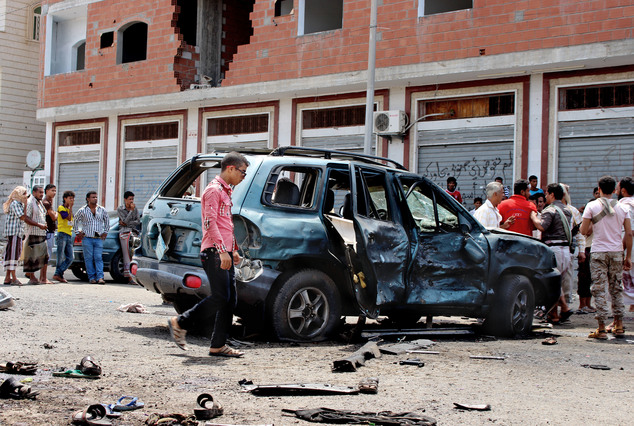
    Yemeni security officials say that a pair of suicide bombers killed at least 45 people in the southern city of Aden.
    The officials said Monday that the two bombers targeted young men seeking to join the army. One suicide car bomber targeted a line outside an army recruitment center, killing at least 20. A second bomber on foot detonated his explosive vest among a group of recruits waiting outside the home of an army commander, killing at least 25.
    The Yemeni officials all spoke on condition of anonymity because they were not authorized to brief the media.
    Yemen's conflict pits the internationally recognized government against Shiite rebels who control the capital, Saana, and are allied with a former president. The country also contains active al-Qaida and Islamic State group affiliates.
    People gather at the scene after a pair of suicide bombings attack in the southern city of Aden, Yemen, Monday, May 23, 2016. Yemeni security officials say that a pair of suicide bombers killed dozens of people in the southern city of Aden. (AP Photo)
    In this photo released by the Syrian official news agency SANA, Syrians gather in front of a burning car at the scene where suicide bombers blew themselves up, in the coastal town of Tartus, Syria, Monday, May 23, 2016. The Syrian TV said suicide bombers blew themselves followed by a car bomb in a parking lot packed during morning rush hour. (SANA via AP)


    Turkey threatens to suspend agreements with EU

    ANKARA, Turkey (AP) — German Chancellor Angela Merkel said she told Turkey's president that Ankara must fulfill all the European Union's conditions, including revisions to anti-terror laws, to secure visa-free travel for its citizens.
    Speaking after meeting President Recep Tayyip Erdogan in Istanbul on Monday, Merkel also expressed concern about a move to strip legislators of their immunity from prosecution. But she underlined her commitment to an EU-Turkey deal aimed at stemming Europe's migrant influx amid rising tensions with Ankara.
    As part of that agreement, the EU planned to accelerate introduction of visa-free entry for Turks. Turkey has fulfilled most of 72 conditions but its refusal to revise anti-terror laws has emerged as a stumbling block.


    Turkey's President Recep Tayyip Erdogan, delivers a speech at the opening ceremony of the World Humanitarian Summit, in Istanbul, Monday, May 23, 2016. World leaders and representatives of humanitarian organisations from across the globe converge in Istanbul on May 23-24, 2016 for the first World Humanitarian Summit, focused on how to reform a system many judge broken. (AP Photo/Lefteris Pitarakis)


    Merkel said in comments aired on German television she made clear that "we need the fulfillment of all points."
    Turkey, however, is complaining of "double standards" by the EU and demanding that Brussels keep its side of the bargain.
    Erdogan's economy adviser, Yigit Bulut, told state-run TRT television Monday that Turkey could make "very radical decisions," including shelving a Customs Union agreement with the EU, if the bloc fails to "meet promises made to Turkish citizens."
    "All sorts of agreements can be suspended, including the Customs Union agreement. All ties with the EU can be revised," Bulut said.


    German Chancellor Angela Merkel, is applauded by Turkey's President Recep Tayyip Erdogan, following her speech during a roundtable meeting on "Political Leadership to Prevent and End Conflicts" at the World Humanitarian Summit in Istanbul, Monday, May 23, 2016. World leaders and representatives of humanitarian organisations from across the globe converge in Istanbul on May 23-24, 2016 for the first World Humanitarian Summit, focused on how to reform a system many judge broken. (Ozan Kose/Pool Photo via AP)


    German Chancellor Angela Merkel, left, talks through an interpreter to Turkey's President Recep Tayyip Erdogan, right, during a roundtable meeting on "Political Leadership to Prevent and End Conflicts" at the World Humanitarian Summit in Istanbul, Monday, May 23, 2016. World leaders and representatives of humanitarian organisations from across the globe converge in Istanbul on May 23-24, 2016 for the first World Humanitarian Summit, focused on how to reform a system many judge broken. (Ozan Kose/Pool Photo via AP)


    Turkey's President Recep Tayyip Erdogan, right, shakes hands with German Chancellor Angela Merkel, prior to their meeting at the World Humanitarian Summit in Istanbul, Monday, May 23, 2016. World leaders and representatives of humanitarian organisations from across the globe converge in Istanbul on May 23-24, 2016 for the first World Humanitarian Summit, focused on how to reform a system many judge broken. (Kayhan Ozer/Pool Photo via AP)

    Saturday, 21 May 2016

    Volcano erupts in western Indonesia, killing 6 people

    JAKARTA, Indonesia (AP) — Rescuers have found more bodies after a volcano erupted in western Indonesia, raising the death toll to six, an official said Sunday.
    Mount Sinabung in North Sumatra province blasted volcanic ash as high as 3 kilometers (2 miles) into the sky on Saturday, said National Disaster Management Agency spokesman Sutopo Purwo Nugroho. He said ash tumbled down the slopes as far as 4.5 kilometers (3 miles) westward into a river.
    The mountain had been dormant for four centuries before reviving in 2010, killing two people. An eruption in 2014 killed 16 people.
    In this image made from video, a man covered in dust leads rescuers after an eruption of Mount Sinabung, in Tanah Karo, North Sumatra, Indonesia, Saturday, May 21, 2016. The volcano in western Indonesian unleashed hot clouds of ash as it erupted on Saturday, killing and injuring a number of villagers. (AP Photo/APTN)

    In this image made from video, dead animals are covered in dust after hot clouds of ash erupted from Mount Sinabung, in Tanah Karo, North Sumatra, Indonesia, Saturday, May 21, 2016. The volcano in western Indonesian unleashed hot clouds of ash as it erupted on Saturday, killing and injuring a number of villagers. (AP Photo/APTN)


    Workers prepare coffins for the victims of the eruption of Mt. Sinabung at a hospital in Kabanjahe, North Sumatra, Indonesia, Sunday, May 22, 2016. The volcano in western Indonesian unleashed hot clouds of ash on Saturday, killing several villagers, an official said. (AP Photo/Binsar Bakkara)


    Villagers and rescuers stand near a burning tree after it was hit by pyroclastic flows from the eruption of Mount Sinabung, background, in Gamber, North Sumatra, Indonesia, Saturday, May 21, 2016. The volcano in western Indonesian unleashed hot clouds of ash as it erupted on Saturday. (AP Photo/Sugeng Nuryono)

    Taliban leader Mansour 'likely killed' in US drone strike

    An American drone strike targeted and "likely killed" Taliban leader Mullah Akhtar Mansour in a remote area of Pakistan, US officials said, in a major and rare American military raid in the country.
    The air strike, authorized by President Barack Obama, also killed a second adult male combatant as the pair traveled in a vehicle southwest of the town of Ahmad Wal near the Afghan border, a US official said.
    "Mansour was the target and was likely killed" by the strikes, which were carried out around 6:00 am (1000 GMT) by multiple unmanned aircraft operated by US Special Operations Forces, the US official added, speaking on conditions of anonymity. There were no other known casualties.
    This handout photograph released by The Afghan Taliban on December 3, 2015, which was taken on a mobile phone in mid-2014 is said to show Afghan Taliban leader Mullah Akhtar Mansour posing for a photograph at an undisclosed location in Afghanistan

    In a statement, Pentagon spokesman Peter Cook said the US military was still assessing whether Mansour had in fact been killed. The deaths of Taliban leaders have often been falsely reported, and Mansour himself was rumored to have been killed in December.

    The United States informed both Pakistan and Afghanistan shortly after the strike, a senior White House official said.
    News of the strike came as US Central Command chief General Joseph Votel made a surprise visit to northern Syria to witness efforts to build up local forces in the fight against the Islamic State group.
    He was the highest-ranking US military official to travel to Syria since its civil conflict began in 2011.
    The United States has focused its counterterrorism efforts on fighting IS in Syria and Iraq, but it also is struggling with a resurgent Taliban in Afghanistan since most US combat troops withdrew at the end of 2014.
    Mansour was "actively involved" with planning attacks across Afghanistan, and presented an "obstacle to peace and reconciliation between the government of Afghanistan and the Taliban, prohibiting Taliban leaders from participating in peace talks with the Afghan government that could lead to an end to the conflict," Cook said.
    Mansour was appointed head of the Taliban in July 2015 following the revelation that the group's founder Mullah Omar had been dead for two years.
    "Since the death of Mullah Omar and Mansour's assumption of leadership, the Taliban have conducted many attacks that have resulted in the death of tens of thousands of Afghan civilians and Afghan security forces as well as numerous US and coalition personnel," Cook said.
    - 'Keep expectations in check' -
    Michael O'Hanlon of the Brookings Institution think-tank said Mansour's death may only "modestly" help the US effort in Afghanistan.
    "The war has been going on for so long, the Taliban has so many leaders and so much ability to function at the local level even without strong central guidance, that we would be well advised to keep expectations in check," he said.
    US lawmakers welcomed the news and some urged the Obama administration to take a firmer stand.
    "I appreciate President Obama for authorizing the attack," Republican Senator Lindsey Graham said, adding "I strongly encourage the Obama administration to not withdraw troops until conditions on the ground permit their withdrawal."
    Republican Senator John McCain, head of the Senate Armed Forces Committee, said he hoped "this strike against the Taliban's top leader will lead the administration to reconsider its policy of prohibiting US forces from targeting the Taliban."
    Pressure has been building in recent months for the United States return to direct engagement with the Taliban, particularly via air strikes.
    "We need to take the gloves off those forces already in-country," namely those belonging to the United States and NATO, and authorize air strikes, David Petraeus, the ex-CIA director and former commander of coalition forces in Afghanistan and Iraq, wrote in The Wall Street Journal this week.
    NATO ended its combat mission in Afghanistan in December 2014, pulling out the bulk of its troops, although a 13,000-strong residual force remains for training and counterterrorism operations.
    The Taliban, which announced the start of its annual spring offensive last month, has already stepped up its campaign against the Western-backed Kabul government for the season.
    Kabul is desperately seeking to bring the insurgent group back to the negotiating table to end their conflict which began in 2001.
    Buoyed by a series of victories on the battlefield, the fighters have so far refused to talk until their conditions are met, including the departure of all foreign soldiers from Afghanistan.
    However, Pakistan on Wednesday hosted a fresh four-nation meeting aimed at reviving the long-stalled direct peace talks.
    - Part of movement from start -
    Born in the southern Afghan province of Kandahar sometime in the early 1960s, Mansour was part of the Taliban movement from its start in the 1990s and has effectively been in charge since 2013, according to Taliban sources.
    He has shunned public appearances. The few pictures believed to be of him show a thickset man with the dark beard and turban that are virtually the uniform for senior Taliban cadres.
    Mansour spent part of his life in Pakistan, like millions of Afghans who fled the Soviet occupation.
    He succeeded Omar, the one-eyed warrior-cleric who led the Taliban from its rise in the chaos of the Afghan civil war of the 1990s.
     Afghan policeman stands guard at a checkpoint on the Kandahar-Tarin Kot highway ©Rateb Noori (AFP/File
    Afghan security personnel keep watch from an armoured vehicle after fighting against Taliban militants at Charkhab in Kunduz province ©Nasir Waqif (AFP/File)
    Relatives carry the coffin of a victim of a Taliban truck bomb attack which killed 30 people and wounded hundreds in Kabul in April ©Shah Marai (AFP/File)

    Friday, 20 May 2016

    It's too late to hide from aliens: Expert says we need to think more carefully about the messages we send to ET


  • Comments made by Douglas Vakoch, president of Meti International
  • He says current signals aimed at ET contain far too little information
  • Meti plans to send its first radio transmission to aliens by end of 2018
  • Some are worried contacting aliens is a bad idea as they may be hostile


  • If an advanced alien civilisation is out there, they probably already know we exist.  
    That's according to a group of researchers who claim we should be more careful about the messages we put out.
    Douglas Vakoch, president of the San Francisco-based non-profit Meti (Messaging Extraterrestrial Intelligence) International, says current signals aimed at ET are too simplistic


    'It's too late to conceal ourselves in the universe, so we should decide how we want to represent ourselves,' Vakoch told Forbes
    'Extraterrestrials may be waiting for a clear indication from us that we're ready to start talking.'
    His team at Meti International has launched a project to develop messages for aliens that are both informative and provocative.
    They plan to send their first radio transmission by the end of 2018, with an emphasis on messages that reveal basic mathematical and scientific concepts.
    'It would be ideal to use a powerful transmitter like those used for planetary radar studies, such as Arecibo Observatory,' said Vakoch. 
    A number of such signals have already been sent, with perhaps the most famous being fired out by the Arecibo radio telescope in 1974. 
    Its binary digits reveals some details about our solar system, humans species and Earth's biochemistry.
    Vakoch says that we should include an instruction manual of sorts so that aliens can decode are messages more easily. 
    ''There are a lot of hidden assumptions embedded in the ways we portray three-dimensional objects on two-dimensional surfaces,' said Vakoch. 
    'Even if aliens use pictures, they may use a different set of conventions to map solid objects onto flat surfaces.' 


    During his interview with Forbes, he also said that the messages need to be far more detailed.
    For instance, instead of sending a few details on biochemistry, we should include the entire Periodic Table of Elements. 
    Some scientists, however, believe we should refrain from containing aliens at all in case they are hostile. 
    In February, a leading scientist involved in the Search for Extraterrestrial Intelligence (Seti) said that if aliens visit our planet, they could take control thanks to their use of superior technologies.